

What We Saved: How Component-Level MacBook Repair Preserves Working Parts
When a MacBook develops a serious hardware problem, the obvious solution can sometimes seem to be replacing a large assembly or even the entire device.
But what if only one component has actually failed?
That is where MacBook Component Level Repair in Dubai can make a difference.
At Prabhat Mac Care, our approach starts with a simple question:
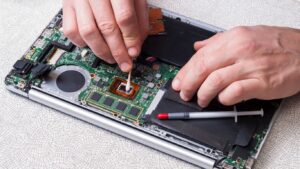
MacBook Component Level Repair Dubai
What actually failed?
Instead of automatically replacing everything around a fault, component-level diagnosis looks for the specific failed component, circuit, connector, or damaged area. When technically possible, repairing that part can allow other working components to remain in use.
This is the idea behind our “What We Saved” concept.
What Does “What We Saved” Mean?
A MacBook contains many individual components that work together.
For example, a single MacBook may contain:
- Display
- Keyboard
- Trackpad
- Battery
- Speakers
- Camera
- USB-C ports
- MagSafe system
- Logic board
- Internal cables
- Connectors
- Housing
If one component fails, the others may continue working normally.
The purpose of component-level repair is to identify the failed area and determine whether it can be repaired without unnecessarily replacing functioning parts.
We don’t just look at what failed.
We also look at what can be saved.
A Failed Component Doesn’t Mean Everything Has Failed
Consider a MacBook that suddenly stops charging.
The problem could involve the:
- Charging port
- USB-C board
- MagSafe board
- Charging circuit
- Battery
- Connector
- Logic-board component
Replacing the entire logic board may not always be necessary.
If diagnosis identifies a specific component or circuit as the cause, a suitable board-level repair may be possible.
What failed?
A specific charging-related component.
What could potentially be saved?
The original logic board and the other working components of the MacBook.
That is the difference between simply replacing parts and diagnosing before replacing.
What We Saved: Real Repair Thinking
The “What We Saved” concept can be applied to almost every type of MacBook repair.
Example 1: Keyboard Problem
Problem: Keyboard has a hardware fault.
What We Replace: The affected keyboard component or appropriate keyboard assembly, depending on the model and diagnosis.
What We Saved:
✓ Display
✓ Trackpad
✓ Speakers
✓ Battery, if healthy
✓ Camera
✓ Logic board
✓ Housing
✓ Other functioning components
The keyboard failed.
The MacBook didn’t.
Example 2: Charging Circuit Problem
Problem: MacBook is not charging because of a board-level charging fault.
Repair: Diagnose and repair the affected circuit or component where technically possible.
What We Saved:
✓ Original logic board
✓ Original storage hardware
✓ Display
✓ Keyboard
✓ Trackpad
✓ Speakers
✓ Battery, if unaffected
✓ Housing
One charging fault does not automatically mean one new MacBook.
Example 3: Liquid Damage
Liquid enters a MacBook and causes electrical problems.
The device may stop charging or powering on.
Instead of immediately declaring the MacBook unusable, technicians can inspect the affected areas and determine what has actually been damaged.
Potentially:
Damaged:
A specific connector, component, circuit, or affected board area.
Saved:
Working display, keyboard, trackpad, storage, speakers, housing, and other unaffected components.
The extent of liquid damage varies from device to device, so repairability must be determined through inspection.
Component-Level Repair vs Complete Replacement
There is an important difference between these approaches.
Traditional replacement approach
Problem → Replace large assembly
Component-level approach
Problem → Diagnose → Identify failed component → Repair where possible → Test
Component-level repair is not about refusing to replace parts.
Sometimes a complete component replacement really is the correct solution.
The goal is to avoid replacing parts that don’t need replacing.
What Can Component-Level MacBook Repair Address?
Depending on the MacBook model and the specific fault, component-level or board-level repair may involve areas such as:
- Charging circuits
- USB-C-related circuitry
- Connectors
- Power circuits
- Backlight circuits
- Damaged traces
- Solder connections
- Individual electronic components
- Liquid-damaged areas
- Board-level connections
Not every fault can be repaired at component level.
The condition of the board, severity of damage, model architecture, availability of parts, and technical feasibility all need to be considered.
That is why diagnosis comes first.
“This Is What We Didn’t Replace”
This is one of the most powerful ways to explain component-level repair to customers.
Instead of only showing a repaired MacBook, show what didn’t need to be replaced.
For example:
Repair:
Charging circuit
We Didn’t Replace:
✓ Entire MacBook
✓ Display
✓ Keyboard
✓ Trackpad
✓ Speakers
✓ Camera
✓ Housing
✓ Working components
The message becomes very simple:
We repaired the problem without unnecessarily replacing everything around it.
Why Preserving Working Parts Matters
Repairing a failed component can help keep other usable components in service.
That matters because a MacBook isn’t just one piece of hardware.
It is a collection of components designed to work together.
If the display is still working, it can potentially continue to be used.
If the keyboard is working, there may be no reason to replace it.
If the speakers are healthy, they can remain in service.
If the housing is undamaged, it doesn’t need to become part of an unnecessary replacement.
- Repair the fault.
- Preserve what still works.
- Reuse the device for longer.
Component-Level Repair and Sustainability
There is also a practical environmental benefit to keeping usable hardware in service.
Replacing a complete assembly when only one component has failed can mean removing other functioning parts from use.
Component-level repair takes a different approach:
- Find the failure.
- Repair the failure.
- Keep the working parts working.
This doesn’t mean every repair automatically has a measurable environmental benefit, and we don’t claim a specific amount of waste or carbon savings without lifecycle data.
But extending the useful life of functioning components is a practical part of a more repair-focused approach.
The “What We Saved” Checklist
Every MacBook repair can potentially tell a different story.
Before Repair
Problem: MacBook won’t charge.
Diagnosis
Fault: Charging-related board component.
Repair
Action: Component-level repair where technically viable.
What We Saved
✓ Original MacBook
✓ Original logic board
✓ Display
✓ Keyboard
✓ Trackpad
✓ Speakers
✓ Camera
✓ Housing
✓ Other functioning components
This is much more meaningful than simply saying:
“MacBook repaired.”
Why Diagnosis Comes First
A good repair begins with questions.
- What is the symptom?
- Which component is affected?
- What caused the failure?
- Is the component repairable?
- Are other components still functioning?
- Would replacing a larger assembly actually be necessary?
Only after these questions are answered should the appropriate repair be recommended.
That’s why at Prabhat Mac Care, diagnosis is an important part of the repair process.
MacBook Component Level Repair in Dubai
If your MacBook has a charging fault, power problem, liquid damage, display issue, connector problem, or other hardware failure, component-level diagnosis may help identify the actual cause.
Prabhat Mac Care provides MacBook repair services in Dubai, including logic-board repair, charging repair, liquid-damage repair, keyboard repair, battery replacement, screen repair, trackpad repair, and other hardware services.
Whether a component can be repaired or needs replacement depends on the MacBook model and the condition of the affected hardware.
The goal is simple:
Repair what failed. Preserve what works.
Final Thoughts: Look at What We Saved
A successful repair isn’t only about the part that was replaced.
It’s also about everything that remained functional.
A damaged charging circuit doesn’t necessarily mean a new MacBook.
A keyboard problem doesn’t necessarily mean replacing the entire computer.
A liquid-damaged board doesn’t automatically mean every internal component is unusable.
And one failed component doesn’t mean everything around it has failed.
That’s the idea behind “What We Saved.”
Diagnose the fault.
Repair what can be repaired.
Preserve what still works.
Replace only when necessary.
If you need MacBook Component Level Repair in Dubai, UAE, contact Prabhat Mac Care for professional diagnosis and repair support.
Prabhat Mac Care
Shop #4, Al Riffa Plaza, Khalid Bin Walid Street, Bur Dubai, Dubai
📞 +971 54 446 2791 💬 Contact us on WhatsApp
What failed matters. But what we saved matters too.
FAQ
1. What is Component Level MacBook Repair in Dubai?
Component Level MacBook Repair involves repairing a particular failed component, circuit, connector, or board-level failure rather than simply changing the part automatically. It is dependent upon the model of the MacBook and the condition it is in.
2. Will the component level repair help in retaining my original MacBook components?
Yes, it will be done when technically feasible. In case of any failure of only one part or a circuit, other components of the computer such as the display, keyboard, track pad, speakers, battery, or housing might not need to be changed. Which all components can be retained would depend on the diagnosis.
3. How does Prabhat Mac Care evaluate my MacBook to be able to repair it?
Prabhat Mac Care first does the diagnosis to find out the exact cause of the problem and then recommends t